









DONGGUAN COWINT NEW MATERIAL TECHNOLOGY CO.,LTD
No.2,West Industrial Road of Jiaoli,Zhongtang Town,Dongguan
Tel: +86-769-88882603 Web:www.cowint2.com
mail: info@cowint.com
my country is a major textile country, with textile output accounting for more than half of the global output. China has become an important processing center for the world's textile industry. In 2014, the output of printed and dyed cloth in my country was about 53.6 billion meters, of which printed cloth accounted for about 25% of the total printed and dyed cloth, about 13.5 billion meters. Traditional printing is an industry with high pollution and high energy consumption. With the increasing environmental pressure of domestic printing and dyeing factories, some printing and dyeing factories are forced to upgrade their projects and adopt more environmentally friendly and energy-saving digital printing production methods. Growing rapidly. Domestic textile digital printing started late, and digital printing accounts for about 4-5% of the total printed fabric, which is about 500 million meters per year. Compared with 20-30% of foreign markets, there is a huge gap. In the future, my country's digital printing industry will maintain an annual compound growth rate of more than 30%, and there is huge room for growth. It is estimated that in 2020, digital printing will account for about 10% of the total printed cloth, or about 1.5 billion meters.
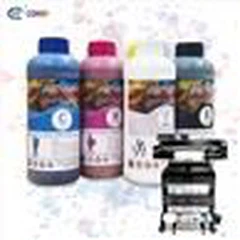
Textile digital printing is mainly divided into four types: disperse, reactive, paint and acid. In the current market distribution, dispersion accounts for about 60%, activity accounts for about 30%, acid accounts for 7%, and paint accounts for about 2%.
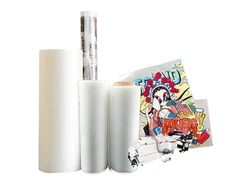
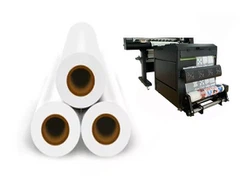
Disperse inks are currently mainly thermal transfer printing, used for polyester fabrics, using low-temperature disperse dye inks, the process is simple, no sewage discharge. The thermal transfer market is currently becoming saturated. The future development trend is to adopt the production mode of sheet cloth direct injection, use high-temperature disperse dye inks, do not require thermal transfer paper, and reduce production costs; the second is to adopt faster industries. Sprinkler.
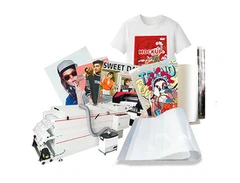
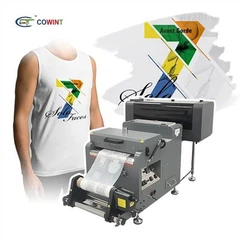
At present, the application of digital paint printing mainly focuses on T-shirts and garment pieces, and the digital paint printing of piece fabric roll-to-roll. There are not many applications at present, and the market has just started, but there is huge room for future growth. From the perspective of market development, due to its simple process, no washing, no sewage discharge, suitable for all fabrics, high light fastness, and environmentally friendly production technology, paint digital printing will develop rapidly in the future, and its main applications For apparel fabrics, T-shirts, bedding, curtains, wall coverings, sofas, etc., the market will be huge. We predict that by 2020, the digital printing of piece cloth will account for about 5-10% of the total output of digital printing, that is, the annual output is 750-120 million meters. This is a huge market.